Due to the US government's misinformation campaign and irresponsible reporting by corporate media, there has been much confusion about the charges in the Michigan 12 case. This page is intended to clarify the facts.
While the federal government's indictment and press releases are filled with allegations of "vandalism," "terrorism," and "antisemitism," these allegations are not reflected in the actual charges in the case.
No defendant has been charged with "vandalism" or property damage (and none of the material damages mentioned in the indictment concerned federal property). The property damages that have been emphasized by the media, such as spray-painting or breaking of a window, are not part of the charges, and no defendant has been charged with these acts at the federal, state, or local level.
No defendant has been charged with "terrorism" or any "hate crime," either. It is simply rhetoric that the government is using to smear the defendants and attempt to sway public opinion against them, knowing that most media will uncritically repeat the government's claims.
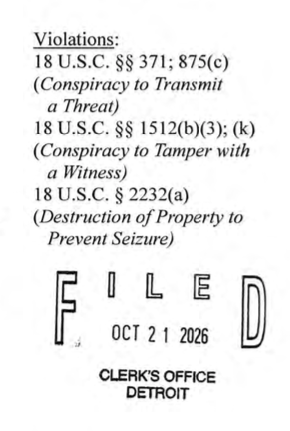
The first and main charge against the Michigan 12 is "conspiracy to transmit threats in interstate or foreign commerce." This charge is about communication, specifically the transmission of messages across state or national borders:
"Whoever transmits in interstate or foreign commerce any communication containing any threat to kidnap any person or any threat to injure the person of another, shall be fined under this title or imprisoned not more than five years, or both." (Title 18, United States Code, Section 371; 875(c))
Internet messages count as communication "in interstate or foreign commerce." In essence, the defendants are charged with sending digital messages, using messaging apps such as Signal or through social media, that the government interprets as "a conspiracy to transmit threats." As the indictment states, this charge means "using the internet to transmit true threats" (allegedly directed at people complicit in the genocide in Palestine) but this basic fact gets buried by the indictment's rhetoric.
The second "conspiracy" charge in the case is "conspiracy to tamper with a witness." Like the first conspiracy charge, this one also boils down to the government's interpretation of internet messages, specifically those allegedly exchanged between some of the defendants.
The third charge in the case (and the only one concerning "property") is "destruction of property to prevent seizure." This is an instance where a defendant has been charged with altering their own device, allegedly to prevent it from being seized by the government. The government presents digital actions, such as one co-defendant allegedly removing another co-defendant from an encrypted group chat, as evidence for this charge.
The use of "conspiracy" charges allows the government to blow the case up to the federal level, and mobilize the FBI against activists, without needing real evidence. The case against the Michigan 12 largely rests on the government's subjective interpretation of internet messages allegedly exchanged between the defendants themselves.
Because of their vague and flexible nature, "conspiracy" charges have historically been used by the US government to repress many social movements, far beyond the Palestine solidarity movement. The federal government is currently using "conspiracy" charges against anti-ICE organizers, as in the case of the Minnesota 15. We will keep fighting against these charges and defending our movements from criminalization.